
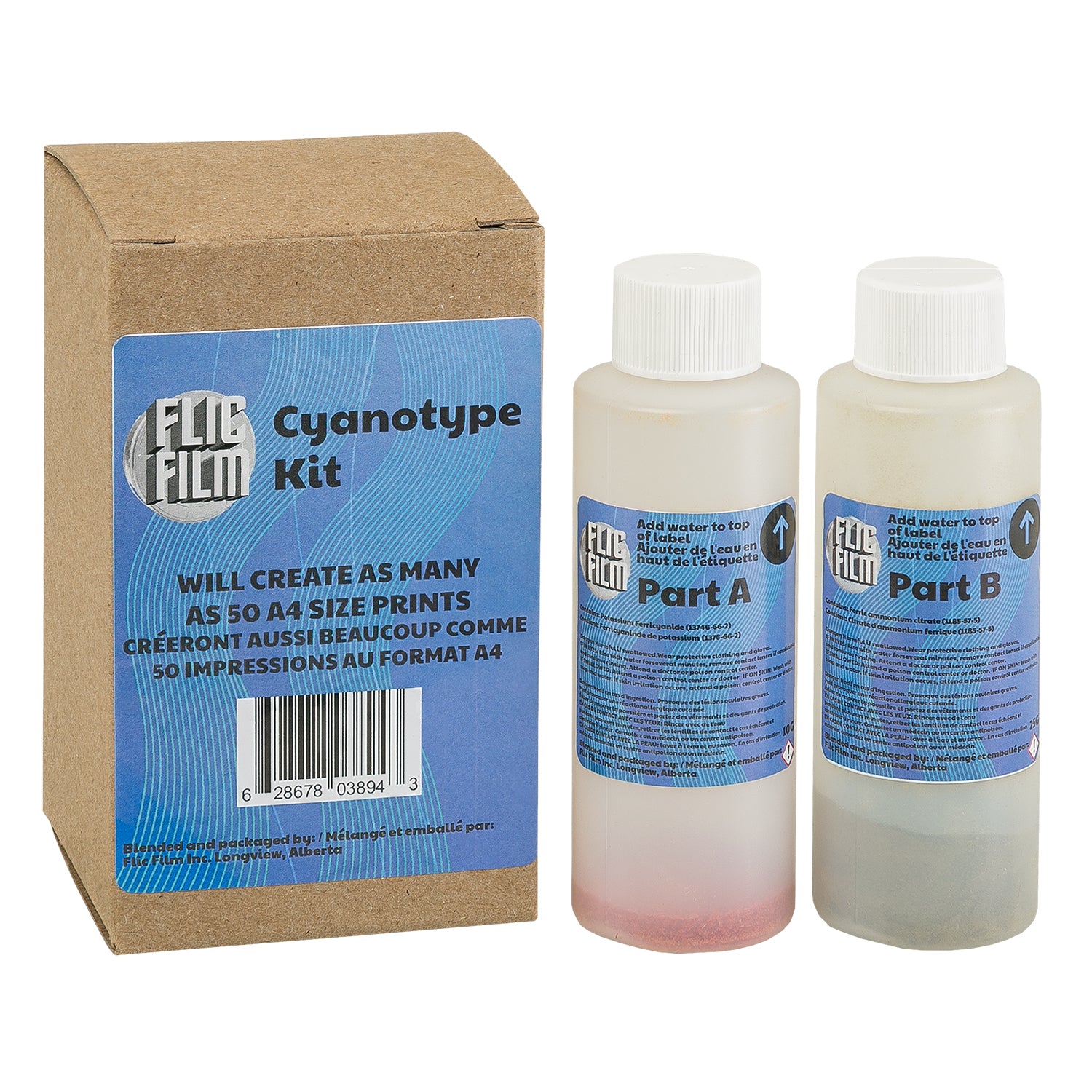
Cyanotype Kit (200ml/400ml)
Export net price including prepaid import tax from EU for orders up to 2500 USD.
(Tariffs for orders with higher value need tp be paid by customer upon arrival. Also additional import duties such as sales tax may apply and must be paid by customer.)
Estimated shipping time to USA: about 10 - 14 days.
Cyanotype, invented by John Herschel in 1842, is a historical analog photographic technique famous for its deep blue, monochromatic images.
In the 19th century, it was used to record botanical studies, maps, plans (blueprints), and documents.
Even today, this photogram technique remains very popular.
This is a very simple photographic process.
Development and fixing are done with tap water; a darkroom is not necessary.
With this chemistry kit, you can coat papers or other natural fibers like cotton, silk, wool, as well as wood or leather, and then expose them as you wish.
Capacity
Cyanotype 200ml Kit:
With this kit, a total of 200ml of cyanotype solution can be mixed. Sufficient for approx. 50 sheets of A4 paper or fabric pieces.
Cyanotype 400ml Kit:
With this kit, a total of 400ml of cyanotype solution can be mixed. Sufficient for approx. 100 sheets of A4 paper or fabric pieces.
How it works:
- The cyanotype chemicals are in powder form in the two plastic bottles. This results in a very long shelf life during storage.
- For use, simply fill the bottles with water up to the marked line to prepare the working solutions for Part 1 and Part 2.
Note: Using distilled water improves the shelf life of the solutions! - By mixing the two parts, you get the light-sensitive cyanotype working solution.
- Then coat the paper or fabric with this solution.
- Place objects, stencils, negative templates, plants, etc. on the paper or fabric as desired. There are no limits to your imagination.
Depending on the template, it may be helpful to weigh down the template with a glass pane. - Expose to UV light for 3-10 minutes, depending on the sun's intensity. Alternatively, you can use our UV exposure kit.
A chemical reaction occurs where UV light hits the cyanotype sheet. - Wash the exposed sheets with cold water for at least 5 minutes until the water no longer shows any discoloration.
The exposed areas will turn blue. - Within 24 hours, the cyanotype images dry and acquire their deep blue tone through oxidation.
To speed up the process, you can optionally add a few drops of hydrogen peroxide to the wash water.
Shelf life of solutions
- The powdered chemicals in the bottles have an almost unlimited shelf life.
- The individual chemicals mixed with water in the bottles have a shelf life of about 6 months - 1 year.
Using distilled water instead of tap water improves shelf life. - The mixed emulsion (chemical solution from bottle 1 + bottle 2) is only stable for about 2-4 hours.
Therefore, it makes sense not to mix more than is needed for the current project.
Processing
- Coated paper is sensitive to UV light --> Place objects or foils on it only in rooms without direct sunlight or in the shade.
- Weigh down objects on the paper/fabric with a glass pane for sharper contours.
- For coating papers or fabrics with emulsion, we recommend our sponge brushes or Hake brushes.
- For creating negative templates, you can also use transparent printing foils from Flix Film, Solarfast, or Fotospeed.
Downloads
> Instructions English
> Instructions French
Product Safety Information
Hazard statements
H315: Causes skin irritation.
H319: Causes serious eye irritation.
H335: May cause respiratory irritation.
Manufacturer:
Flic Film
107D Morrison Road
Longview
Alberta, T0L 1H0
Canada
flicfilminc@gmail.com
Responsible person within the EU / Importer:
C/ Séquia Calvera, 34
46910 Sedaví (VALENCIA)
 |
Choose options
Cyanotype, invented by John Herschel in 1842, is a historical analog photographic technique famous for its deep blue, monochromatic images.
In the 19th century, it was used to record botanical studies, maps, plans (blueprints), and documents.
Even today, this photogram technique remains very popular.
This is a very simple photographic process.
Development and fixing are done with tap water; a darkroom is not necessary.
With this chemistry kit, you can coat papers or other natural fibers like cotton, silk, wool, as well as wood or leather, and then expose them as you wish.
Capacity
Cyanotype 200ml Kit:
With this kit, a total of 200ml of cyanotype solution can be mixed. Sufficient for approx. 50 sheets of A4 paper or fabric pieces.
Cyanotype 400ml Kit:
With this kit, a total of 400ml of cyanotype solution can be mixed. Sufficient for approx. 100 sheets of A4 paper or fabric pieces.
How it works:
- The cyanotype chemicals are in powder form in the two plastic bottles. This results in a very long shelf life during storage.
- For use, simply fill the bottles with water up to the marked line to prepare the working solutions for Part 1 and Part 2.
Note: Using distilled water improves the shelf life of the solutions! - By mixing the two parts, you get the light-sensitive cyanotype working solution.
- Then coat the paper or fabric with this solution.
- Place objects, stencils, negative templates, plants, etc. on the paper or fabric as desired. There are no limits to your imagination.
Depending on the template, it may be helpful to weigh down the template with a glass pane. - Expose to UV light for 3-10 minutes, depending on the sun's intensity. Alternatively, you can use our UV exposure kit.
A chemical reaction occurs where UV light hits the cyanotype sheet. - Wash the exposed sheets with cold water for at least 5 minutes until the water no longer shows any discoloration.
The exposed areas will turn blue. - Within 24 hours, the cyanotype images dry and acquire their deep blue tone through oxidation.
To speed up the process, you can optionally add a few drops of hydrogen peroxide to the wash water.
Shelf life of solutions
- The powdered chemicals in the bottles have an almost unlimited shelf life.
- The individual chemicals mixed with water in the bottles have a shelf life of about 6 months - 1 year.
Using distilled water instead of tap water improves shelf life. - The mixed emulsion (chemical solution from bottle 1 + bottle 2) is only stable for about 2-4 hours.
Therefore, it makes sense not to mix more than is needed for the current project.
Processing
- Coated paper is sensitive to UV light --> Place objects or foils on it only in rooms without direct sunlight or in the shade.
- Weigh down objects on the paper/fabric with a glass pane for sharper contours.
- For coating papers or fabrics with emulsion, we recommend our sponge brushes or Hake brushes.
- For creating negative templates, you can also use transparent printing foils from Flix Film, Solarfast, or Fotospeed.
Downloads
> Instructions English
> Instructions French
Product Safety Information
Hazard statements
H315: Causes skin irritation.
H319: Causes serious eye irritation.
H335: May cause respiratory irritation.
Manufacturer:
Flic Film
107D Morrison Road
Longview
Alberta, T0L 1H0
Canada
flicfilminc@gmail.com
Responsible person within the EU / Importer:
C/ Séquia Calvera, 34
46910 Sedaví (VALENCIA)
|
If you have any questions or concerns, please do not hesitate to contact us.
Best shipping
We ship your goods as quickly and safely as possible.
We process your payment information and other data securely.